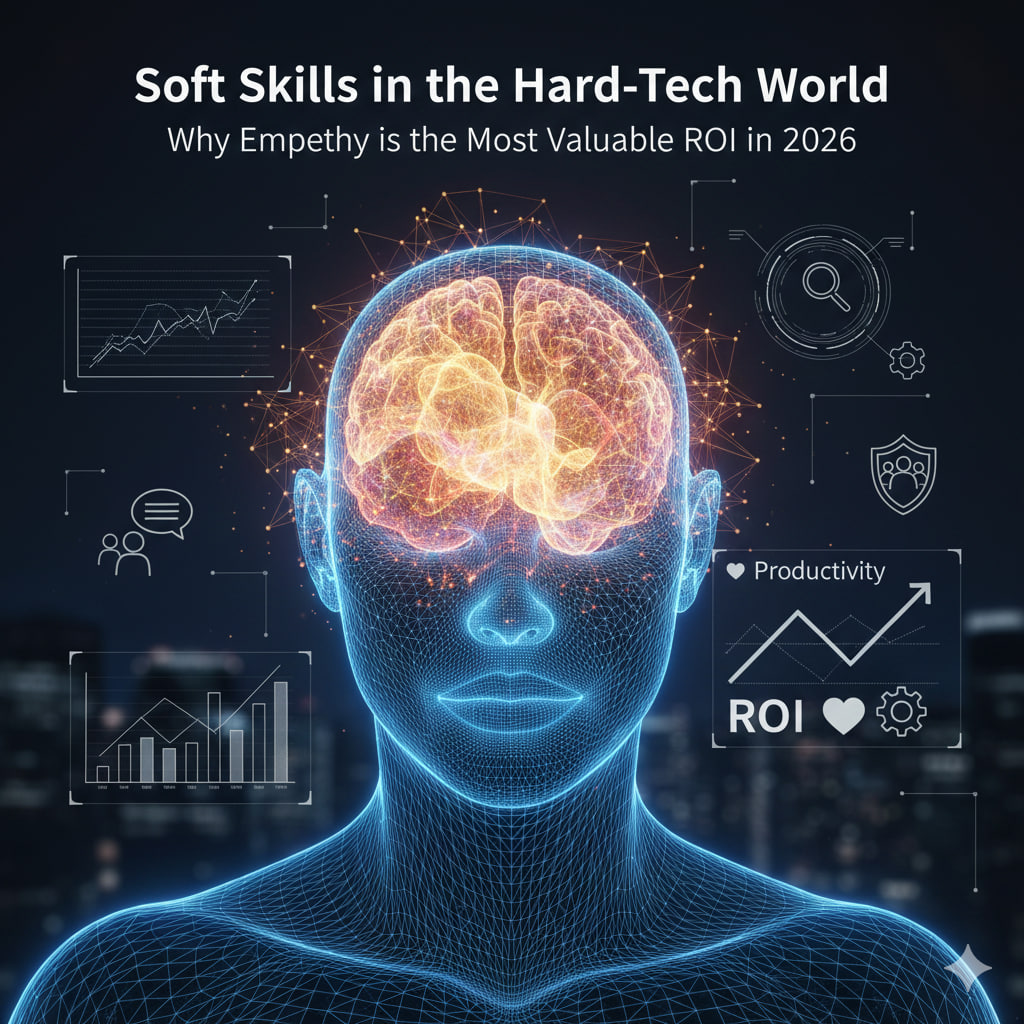
Soft Skills in a Hard-Tech World: Why Empathy is the Most Valuable ROI in 2026
In 2026, technical proficiency has become a commodity. With AI capable of writing flawless code, generating complex financial models, and managing logistics in seconds, the “hard skills” that once guaranteed a six-figure salary are now the baseline.
The new premium? Human-to-Human (H2H) intelligence. Specifically, Empathy has transitioned from a “nice-to-have” HR buzzword to the single most important metric for Return on Investment (ROI) in the modern enterprise.
The Paradox of Automation
As we automate more of our analytical tasks, the value of the remaining human tasks skyrockets. We call this the Paradox of Automation: The more high-tech our world becomes, the more high-touch our leadership must be.
In a world of algorithmic decisions, empathy is the “circuit breaker” that prevents systemic bias, preserves company culture, and drives customer loyalty.
Why Empathy Drives the Bottom Line
Empathy isn’t just about “being nice”—it is a sophisticated cognitive tool for data gathering and risk management.
1. Retention and “Brain Drain” Prevention
In the hybrid-work era, employees are no longer bound by geography. They stay where they feel seen.
- The ROI: Replacing a high-level employee costs roughly 1.5x to 2x their annual salary. Empathetic leaders reduce turnover by an average of 30%, saving millions in recruitment and lost productivity.
2. Conflict De-escalation in Virtual Teams
Digital communication lacks the nuance of body language, leading to frequent “tone-deaf” misunderstandings.
- The Skill: An empathetic manager can sense “digital friction” (low engagement in Slack, camera-off trends) and intervene before a minor misunderstanding becomes a project-killing conflict.
3. User-Centric Innovation
AI can tell you what people are doing, but only empathy can tell you why.
- The ROI: Empathy allows product teams to map the emotional journey of a user. This insight leads to products that solve actual human frustrations rather than just adding features for the sake of technology.
The “Empathy Stack”: Developing the Skill
You can’t “install” empathy, but you can build the neural pathways for it through deliberate practice:
| Skill Component | Business Application | Daily Practice |
| Active Listening | Client Discovery Calls | Repeat back what you heard before responding: “If I understand correctly, you’re feeling… is that right?” |
| Perspective Shifting | Stakeholder Management | Ask: “If I were in their position with their specific pressures, why would this proposal be scary to me?” |
| Cognitive Empathy | Strategic Negotiation | Understanding an opponent’s mental state to find “Win-Win” outcomes that AI cannot calculate. |
The 2026 Leadership Shift
| 2020 Leadership (Command & Control) | 2026 Leadership (Connect & Calibrate) |
| Focus on “Throughput” | Focus on “Psychological Safety” |
| Management by Monitoring | Management by Outcomes and Trust |
| High EQ is optional | High EQ is the primary hiring filter |
“AI can simulate logic perfectly, but it cannot feel the weight of a decision. That weight is the human burden, and empathy is how we carry it together.”
In the hard-tech world of 2026, the most “technically advanced” thing you can do is be deeply, authentically human.
Leave a Reply