Beyond the Prompt: Advanced Techniques to Turn AI into Your Personal Research Team
In 2026, we have moved past the “Vending Machine” era of AI. If you are still just “asking questions,” you are only using 10% of the technology’s capability. To truly unlock AI, you must stop treating it as an encyclopedia and start treating it as a Research Department.
Advanced researchers now use Agentic Workflows—systems where the AI doesn’t just answer, but plans, executes, cross-references, and critiques its own work.
1. From “Prompting” to “Orchestration”
The secret to 2026 research is Chain-of-Thought (CoT) and Tree-of-Thought (ToT) reasoning. Instead of one long prompt, you break the task into a multi-step pipeline.
- The Researcher (Step 1): Instruct the AI to find 10 diverse perspectives on a topic.
- The Analyst (Step 2): Use a second AI instance (or a distinct prompt) to identify contradictions between those 10 perspectives.
- The Fact-Checker (Step 3): Ask the AI to play “Devil’s Advocate” and try to disprove its own previous analysis.
2. The “Agentic” Toolkit for 2026
| Tool Type | 2026 Industry Standard | Best For |
| Grounded Discovery | NotebookLM | Uploading 50+ PDFs and “chatting” only with your specific sources (Zero Hallucination). |
| Evidence Extraction | Consensus / Elicit | Searching 200M+ academic papers and getting a “Consensus Meter” on scientific agreement. |
| Synthesis Engines | ChatGPT Deep Research | Long-form, multi-hour autonomous research that crawls the live web and synthesizes deep reports. |
3. Advanced Technique: Observational Framing
A major shift in 2026 is moving from Evaluative to Observational framing.
- Old Way (Evaluative): “Explain why this technology is better than that one.” (This forces the AI to pick a side and hallucinate supporting “facts.”)
- New Way (Observational): “Compare these two technologies and report the specific patterns you observe in their use cases. What are the common points of failure for both?”
Pro Tip: By removing the “Confidence Demand,” you allow the AI to report uncertainty, which is far more valuable for real research.
4. Building Your “Research Circle” (Holacratic AI)
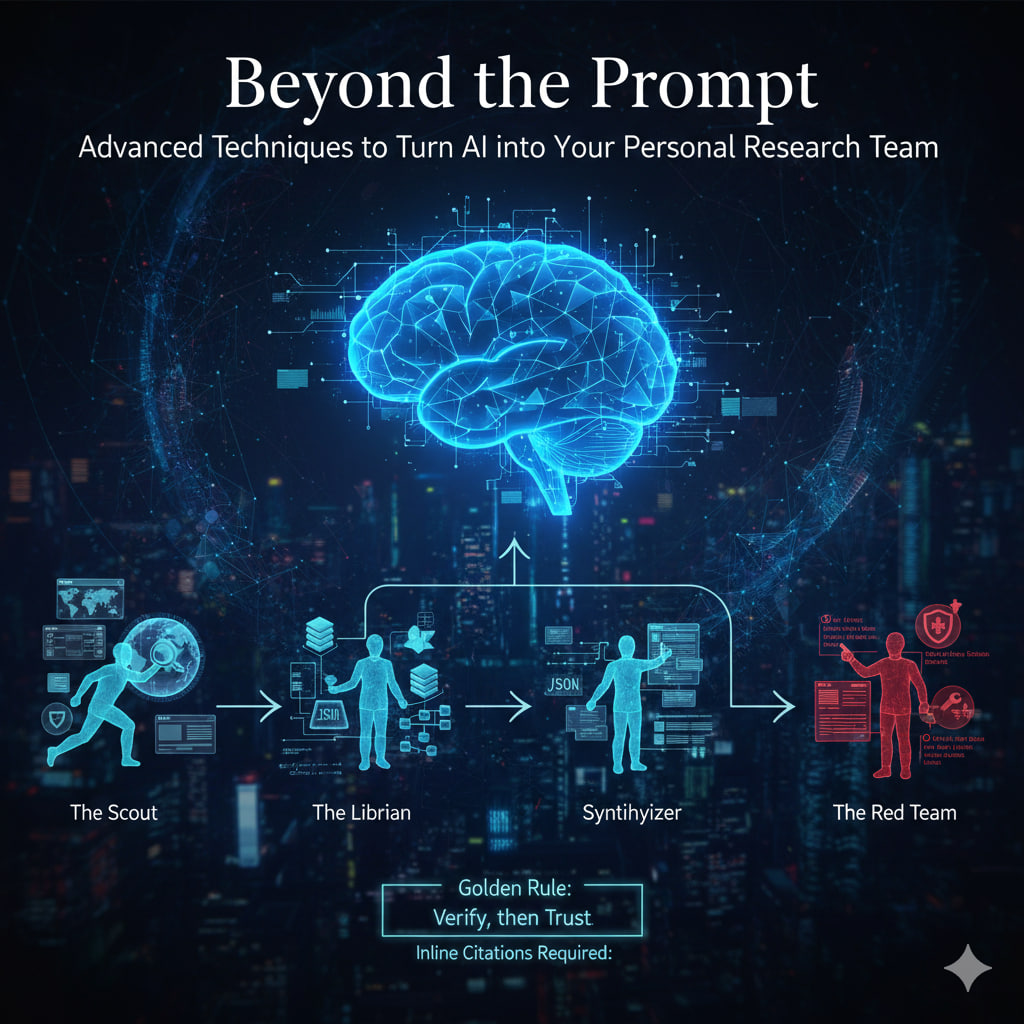
Modern researchers build AI Personas that work together in a digital “Circle”:
- The Scout: Scans the web for the latest data.
- The Librarian: Organizes the data into structured tables or JSON.
- The Synthesizer: Writes the final executive summary.
- The Red Team: Specifically looks for biases, outdated information (pre-2025), or logical fallacies in the summary.
The “Golden Rule” of 2026 Research
Verify, then Trust. > Use AI to find the needle in the haystack, but never let it tell you what the needle is made of without a direct citation link. In 2026, a research paper without Inline Citations is considered a draft, not a finished product.
Leave a Reply