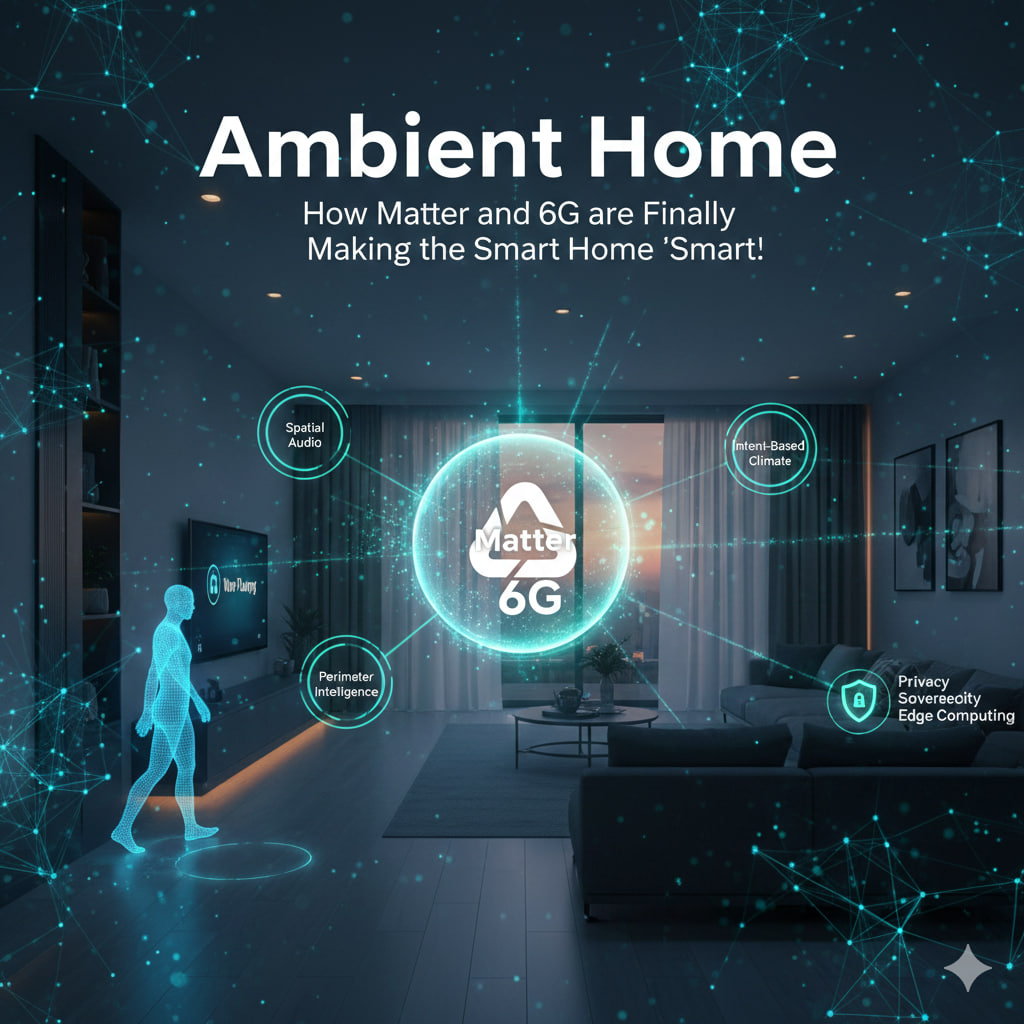
The Ambient Home: How Matter and 6G are Finally Making the Smart Home “Smart”
For years, the “smart home” was more of a “polite hobby.” It required dozens of fragmented apps, constant troubleshooting, and a frustrating amount of manual input. You didn’t live in a smart home; you managed a digital museum of gadgets.
By 2026, two massive technological waves—Matter and 6G—have converged to create the Ambient Home. In this new era, technology isn’t something you use; it’s something that happens around you, quietly and invisibly.
The Two Pillars of Ambient Living
1. Matter: The Universal Translator
Before 2024, if you bought a smart bulb, you had to check if it worked with “Apple Home,” “Google Home,” or “Alexa.” Matter has ended the “walled garden” era. It is a unified communication standard that allows devices from different brands to talk to each other directly.
- The Result: Your Philips Hue lights can now trigger your Google Nest thermostat to lower the temperature when the curtains (by Ikea) close for a movie. No bridges, no hubs, no headaches.
- Local Processing: Matter runs locally on your home network. If your internet goes out, your smart home still works.
2. 6G: The Nervous System
While 5G brought speed, 6G (entering early commercial rollout in 2026) brings Microsecond Latency and Spatial Intelligence.
- Zero Lag: At speeds potentially reaching 1 Tbps, devices react at the speed of human thought.
- Sensor Fusion: 6G uses “Terahertz waves” which can act like a low-resolution radar. This allows your home to “see” your posture—detecting if an elderly relative has fallen or if you’ve simply sat down on the couch—without using privacy-invasive cameras.
From “Reactive” to “Predictive” Automation
In 2026, we’ve moved past the “Hey Siri, turn on the lights” phase. The Ambient Home is Intent-Based.
| Feature | The 2022 Version (Reactive) | The 2026 Version (Ambient) |
| Lighting | You press a button or say a command. | Lights track your movement, dimming behind you and brightening ahead of you. |
| Climate | You set a schedule on your phone. | AI analyzes the local weather forecast and your biometric data (via your watch) to adjust the temp before you feel cold. |
| Security | You check a camera feed. | Perimeter Intelligence: The home distinguishes between a delivery driver, a neighbor, and a stranger, only alerting you if an anomaly is detected. |
The “Invisible” Interface
The most significant trend of 2026 is the Disappearing Screen.
- Voice + Emotion: 6G-powered AI can now detect stress or fatigue in your voice, automatically playing calming audio or shifting lighting to “Crest” mode to boost your mood.
- Spatial Audio: Sound follows you from room to room. Your podcast doesn’t stop; it simply “migrates” to the speakers in the kitchen as you walk in to grab a coffee.
The Privacy Trade-off
Note: Ambient technology requires a massive amount of “Contextual Data.” In 2026, the leading smart home brands compete on Privacy Sovereignty. The “Edge Computing” trend ensures that your heart rate, movement patterns, and voice snippets are processed on a small chip in your home wall, rather than being sent to a corporate cloud.
How to “Ambient-ize” Your Home Today
- Look for the Logo: Only buy devices with the Matter over Thread logo. These are the most future-proof.
- Audit Your Hubs: Switch to a “Universal Controller” (like the latest Apple HomePod or Google Nest Hubs) that acts as a Matter Border Router.
- Invest in Sensors, Not Switches: The key to an ambient home is Presence Sensors (like the Aqara FP2), which detect “static presence” (sitting still) rather than just “motion.”
Leave a Reply