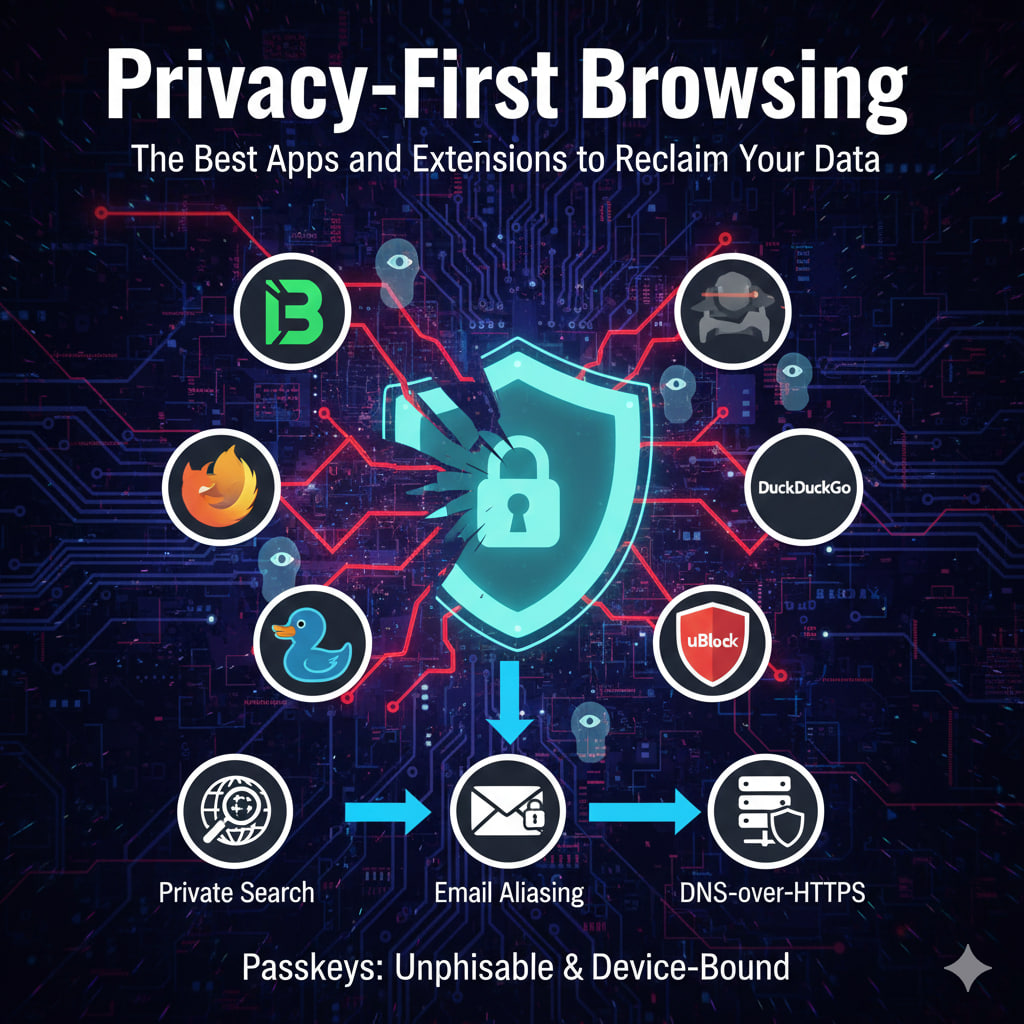
Privacy-First Browsing: The Best Apps and Extensions to Reclaim Your Data
In 2026, the internet is no longer just “watching” you; it is actively profiling you using AI-driven behavioral tracking. Standard “Incognito” modes are largely a placebo—they hide your history from your spouse, but not from the data brokers.
To truly reclaim your data, you need a stack that addresses Fingerprinting (making your browser look unique) and Telemetry (the data your browser sends back to its creator).
The 2026 Browser Power Rankings
Choosing a browser in 2026 depends on your specific “Threat Model.” Are you hiding from advertisers, or are you seeking total anonymity?
| Browser | Best For | Standout 2026 Feature |
| Brave | Daily Performance | Shields v3: Automatically blocks 97% of trackers and “bounce tracking” by default. |
| Firefox (Hardened) | Customization | One-Click Privacy Tool: A new 2026 feature that audits and revokes data permissions globally. |
| Mullvad Browser | Anti-Fingerprinting | Designed with the Tor Project to make your browser look identical to every other Mullvad user. |
| Kahf Browser | Family Safety | Ranks #1 in 2026 for AI-powered content filtering and tracker blocking (99.7%). |
| Tor Browser | Maximum Anonymity | Routes traffic through three layers of encryption; slow, but the gold standard for journalists. |
Essential 2026 Privacy Extensions
If you aren’t ready to switch your browser, you must “harden” your existing one with these essential add-ons:
- uBlock Origin: Still the king. In 2026, it is essential for blocking “malvertising” and heavy script-based trackers.
- Decentraleyes: Prevents your browser from “calling home” to large Content Delivery Networks (like Google or Amazon) for basic web files.
- Cookie AutoDelete: Automatically wipes cookies the moment you close a tab, preventing “cross-site” tracking.
- ClearURLs: Many links in 2026 contain long strings of tracking code (e.g.,
?utm_source=...). This extension strips them automatically before the page loads.
The “Privacy Stack” Beyond the Browser
Browsing is only one part of your digital footprint. To truly disappear from the “Data Economy,” consider these three tools:
1. Private Search Engines
Stop using search engines that “personalize” results (which is code for “building a profile”).
- Brave Search: Uses its own independent index rather than relying on Google/Bing.
- DuckDuckGo: The classic choice, now featuring an integrated “App Tracking Protection” for mobile.
- Mojeek: A true “no-log” crawler based in the UK with a completely independent index.
2. Email Aliasing (The “Burner” Strategy)
Never give your real email to a website. Use SimpleLogin or DuckDuckGo Email Protection to generate unique aliases. If a site starts spamming you or sells your data, you can simply delete that specific alias.
3. DNS-over-HTTPS (DoH)
Even if you use a private browser, your Internet Service Provider (ISP) can see which websites you visit via your DNS requests. Switching to NextDNS or Cloudflare (1.1.1.1) encrypts these requests, hiding your destination from your ISP.
The 2026 Pro-Tip: Passkeys over Passwords
As of early 2026, nearly 50% of major websites support Passkeys. Unlike passwords, passkeys cannot be phished because they are tied to your physical device. Switching to passkeys removes the “Credential Leak” risk that often leads to identity theft.
“Data is the new oil, but your privacy is the new gold. Don’t give it away for the convenience of a ‘Remember Me’ button.”
Leave a Reply