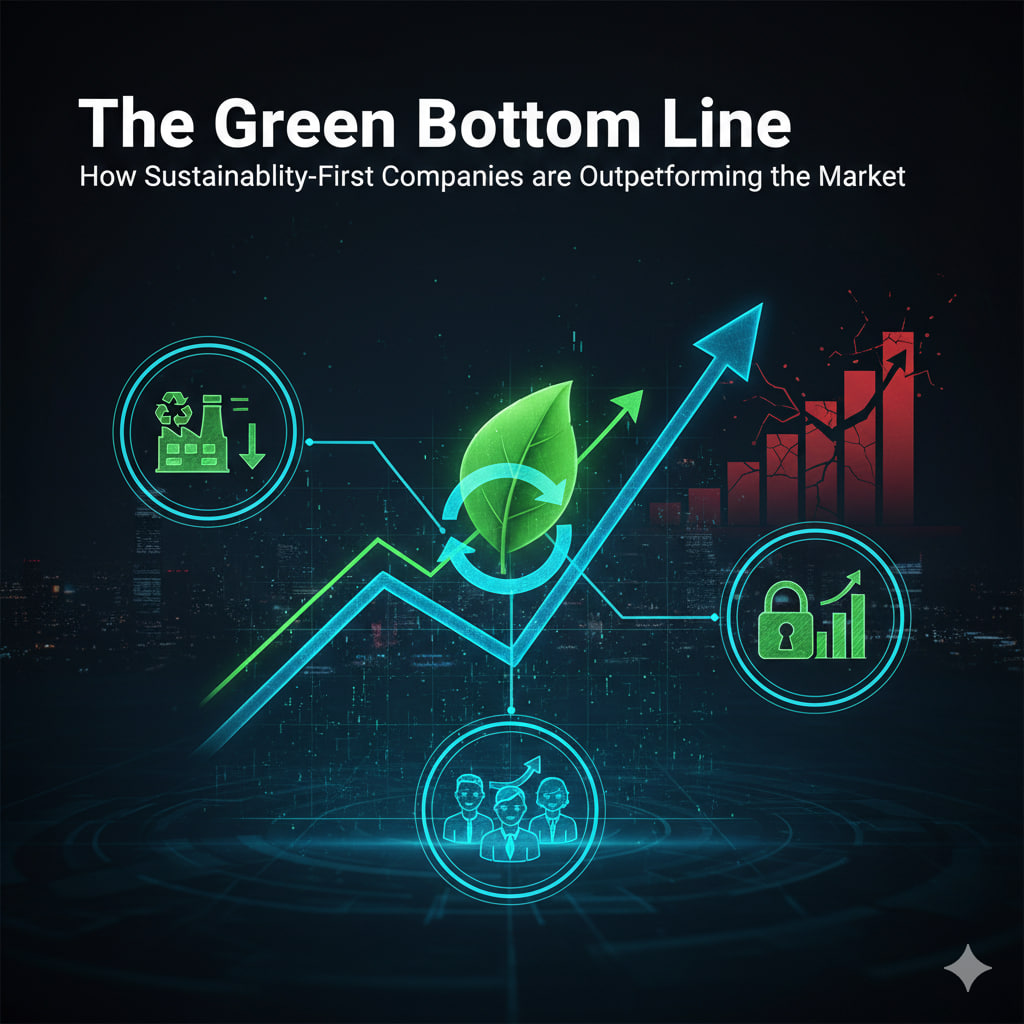
The Green Bottom Line: How Sustainability-First Companies are Outperforming the Market
For decades, the prevailing corporate wisdom was that sustainability was a “cost center”—an expensive philanthropic endeavor that came at the expense of shareholder profits.
By 2026, that narrative has been completely inverted. Data from the global markets shows a clear trend: companies that prioritize Environmental, Social, and Governance (ESG) metrics are not just “doing good”—they are consistently outperforming their less-sustainable competitors in terms of stock price, talent acquisition, and long-term resilience.
The “Sustainability Premium”
Why are green companies winning? It’s not just about positive PR; it’s about Efficiency and Risk Mitigation.
1. Resource Circularity equals Cost Savings
Sustainability-first companies don’t just “reduce waste”; they implement Circular Economy models. By designing products that can be easily refurbished or recycled, they reduce their dependence on volatile raw material markets.
- The ROI: Companies using circular supply chains have seen a 15–20% reduction in manufacturing costs as they “mine” their own old products for parts.
2. The War for Talent
In 2026, the labor market is driven by values. Over 75% of Gen Z and Millennial workers—who now make up the majority of the global workforce—state they would take a pay cut to work for a company with a strong environmental mission.
- The ROI: Lower turnover rates and higher employee engagement lead to significantly lower recruitment costs and higher “Output per Human Hour.”
3. Lower Cost of Capital
Financial institutions have recognized that climate change is a financial risk. Consequently, “Green Bonds” and sustainability-linked loans offer lower interest rates to companies that hit specific carbon-reduction targets.
- The ROI: Sustainability-first firms often enjoy a 50 to 100 basis point advantage in their cost of debt compared to “Brown” (polluting) firms.
The Risk of the “Laggard Penalty”
While green companies are rewarded, “laggards” are facing a mounting penalty:
- Stranded Assets: Fossil-fuel-heavy infrastructure is being devalued faster than anticipated.
- Regulatory Walls: New carbon taxes in the EU and North America are turning “cheap” polluting processes into “expensive” liabilities.
How to Implement a “Green Bottom Line” Strategy
Moving toward sustainability requires a shift from compliance to strategy.
| Focus Area | Traditional Approach | Sustainability-First Approach |
| Supply Chain | Lowest cost, regardless of source. | Resilience-First: Localized, low-carbon, and ethically audited. |
| Product Design | Planned obsolescence. | Design for Longevity: Modular parts and “Product-as-a-Service” models. |
| Reporting | Financials only. | Double Materiality: Reporting on how the world affects the company and how the company affects the world. |
The 2026 Verdict
The “Green Bottom Line” proves that the interests of the planet and the interests of the portfolio are finally aligned. In the high-transparency era of 2026, you cannot hide a dirty supply chain, and you cannot afford the inefficiency of waste.
“Sustainability is no longer a moral choice; it is a fiduciary duty. If you aren’t green, you’re eventually going to be in the red.”
Leave a Reply